.jpg)
Jo Stevens, Managing Director, Oxford Innovation Space
October 2026
I joined Oxford Innovation Space in November 2000 as the manager of Culham Innovation Centre. Twenty-six years later, I still get the same feeling walking into one of our centres: the energy of people building something that matters. That feeling is what Oxford Innovation Space was created for. When Sir Martin and Lady Audrey Wood — founders of Oxford Instruments — established this company in 1987, they wanted to give back to the ecosystem that had supported their own journey from a garden shed to a global science company. Our founding principle hasn't changed: we exist to support entrepreneurs with the challenges of growing a business. Founded by entrepreneurs, to support entrepreneurs.
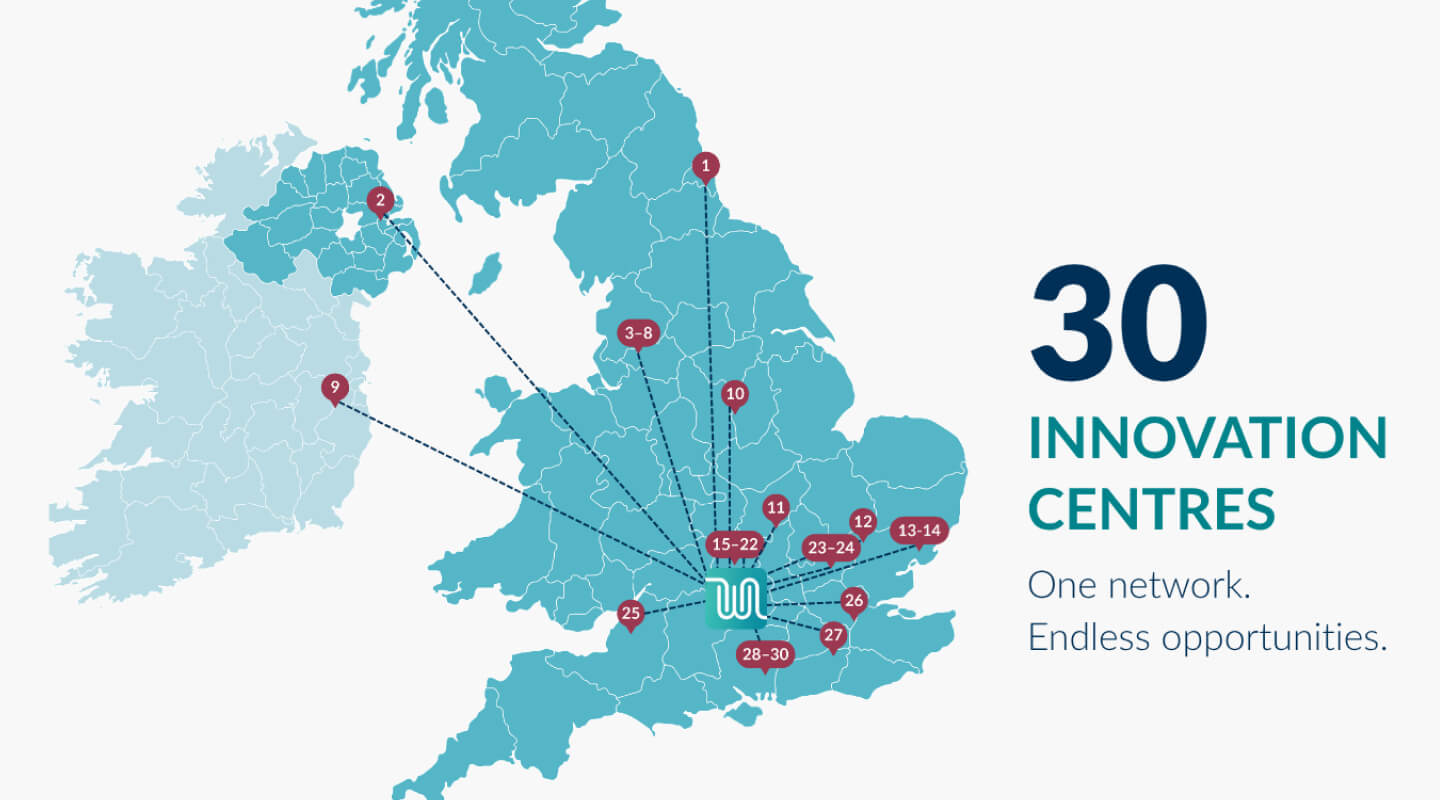
Today, that mission plays out across 32 innovation centres, over 1 million square feet of space, and more than 1,000 innovative SMEs — from pre-revenue start-ups in Belfast to scaling deep-tech businesses in Bristol, from advanced manufacturers in Stockport to space technology companies in Oxfordshire. We are the UK and Ireland's largest dedicated innovation centre operator, and I am immensely proud of the team of 150 people who make it work every day.
So why, after almost 40 years of doing this, did we decide to pursue B Corp accreditation?
Formalising what we already believe in
The honest answer is: accountability.
For years we have talked about balancing commercial performance with positive social and environmental impact. We've backed that up with action — Real Living Wage accreditation since 2020, ISO 9001 and ISO 14001 certifications since 2010, the Good Business Charter, Cyber Essentials, and a comprehensive Net Zero roadmap developed with Positive Planet (our total carbon footprint in FY24/25 was 3,567 tCO2e, with 69% in Scope 3). We measure our social value through the TOMs framework, aligned to the UN Sustainable Development Goals. We've installed defibrillators across our network — something close to my heart as Chair of the Heart of Oxford Business Board for the British Heart Foundation.
But accreditations can sit in a drawer. What I wanted was a single, rigorous, independently verified framework that held us accountable across everything we do — our governance, how we treat our people, the impact we have on our communities, our environmental stewardship, and the value we create for our customers. That's exactly what B Corp provides.
B Corp assesses organisations across five impact areas: Governance, Workers, Community, Environment, and Customers. You need a minimum score of 80 out of 200 to certify, with the median business scoring just 50.9. It's not a tick-box exercise. The verification process, led internally by our Director of Organisational Improvement Lisa Richardson, took months of rigorous evidence-gathering, policy development, and honest self-assessment. And that was the point — the process itself made us better. I’m thrilled that we have achieved an B Corp accreditation score of 85.9%.
From culture to impact
Oxford Innovation Space has been employee-owned since the SQW Group management buy-out in 2018. That ownership structure shapes everything — from the way I run our Monthly Company Call (where we share our financial, operational, and commercial performance openly with every colleague) to the way we invest in people. Since I became Managing Director in 2017, we've nearly doubled the number of full-time employees, with team members progressing from entry-level roles to senior leadership positions. Every one of them is paid at least the Real Living Wage.
It's worth noting that 14% of UK B Corps are employee-owned, compared to less than 1% of all UK businesses. There is a natural alignment between employee ownership and the B Corp ethos — when your people are your shareholders, decisions get made with a longer time horizon and a broader sense of responsibility.
But B Corp isn't just about internal culture. It's about the impact we create in the places we operate.
At Future Space, in partnership with UWE Bristol, we’ve supported 180 businesses creating almost 1,000 jobs and to launch 585+ products over 10 years. At The EpiCentre in Haverhill, 172 companies have been supported, with businesses raising over £150 million in funding and creating more than 300 jobs. At Salford Innovation Forum, we grew occupancy from 50% to 79%, supporting 80+ businesses, unlocking over £550,000 in funding, and housing 15+ charities and social enterprises. Through The Wire — our digital innovation community — we now connect 1,464 members from 663 businesses, with an 821% surge in re-engagement over the past year. And our strategic alliance with London Gatwick is pioneering a new model for embedding innovative SMEs directly into major corporate supply chains.
These aren't vanity metrics. They represent real businesses, real jobs, and real economic impact in communities across the country.
The right moment
The timing of our B Corp accreditation is not accidental. The UK's Modern Industrial Strategy, published in 2025, explicitly recognises innovation centres as critical infrastructure — places where the 'quadruple helix' of government, industry, academia, and community comes together to drive growth. Local authorities are increasingly acting as active market-makers, commissioning innovation spaces as tools of economic development. The Procurement Act 2023 has strengthened social value requirements in public contracts.
In this landscape, being able to demonstrate independently verified social and environmental performance isn't a nice-to-have — it's becoming essential. B Corp gives us, and our clients, that evidence.
The data supports this approach. B Lab UK's 10-year impact report shows that UK SME B Corps grew turnover by 20% between 2024 and 2025, compared to just 3% for all UK SMEs. They secured 18% more external funding. They were significantly more likely to have survived the pandemic. Purpose and performance are not in tension — they reinforce each other.
What this means for our customers
For the 1,000 innovative SMEs based in our centres, our B Corp accreditation has practical implications.
If you're an early-stage business responding to ESG due diligence from investors, or bidding for a public sector contract with social value requirements, being based in a B Corp-certified innovation centre is a meaningful proof point. It signals to your clients, your investors, and your partners that you operate in an environment committed to responsible business practices.
Our Net Zero commitment — including annual carbon reporting and a target of 100% renewable energy across our network by 2027 — directly benefits customers seeking to reduce their own Scope 3 emissions. And B Corp's seven Impact Topics — from Climate Action to Fair Work, from Environmental Stewardship to Justice, Equity, Diversity and Inclusion — align closely with the priorities of the innovative, growth-oriented SMEs we support.
We are not the first innovation space operator to achieve B Corp, and we won't be the last. But we believe we are the first to do so at this scale — across 32 centres and over 1 million square feet — while maintaining embedded business support at every single site. That combination of scale, specialism, and independently verified values is, I believe, unique.
A continuous journey
B Corp accreditation is not a destination. It requires recertification every three years and annual impact reporting. B Lab's new Standards V2, published in April 2025, raises the bar further — moving from cumulative scoring to mandatory requirements across all seven Impact Topics. We welcome that. Continuous improvement is in our DNA.
When I think about why we pursued B Corp, I keep coming back to our founding story. Sir Martin Wood built Oxford Instruments by turning brilliant science into world-changing technology. Then he and Lady Audrey created Oxford Innovation Space to help other people do the same. Nearly four decades later, B Corp accreditation is our way of saying: we measure success not just by the rent we collect, but by the businesses we help build, the jobs we help create, the communities we help strengthen, and the planet we're committed to protecting.
We call it being Space for Good. I'd like to think Sir Martin would approve.
If you're a customer, a partner, a local authority, a university, or a developer who shares these values, I'd love to hear from you. This is a journey, and it's one we want to make together.
About the author: Jo Stevens MiED is Managing Director of Oxford Innovation Space, the UK and Ireland's largest operator of innovation centres. She joined the company in 2000 and became MD in 2017. Jo is a regular national and international speaker on innovation-led placemaking, a former Director of the UK Science Park Association (UKSPA), and Chair of the Heart of Oxford Business Board for the British Heart Foundation. She was awarded the iED Leader of the Year Award in 2025. Oxford Innovation Space is part of the employee-owned SQW Group.